

Dr. Dirk Kremer
Dr. Dirk Kremer

If you’re searching for the best deep plane facelift surgeon London, UK, you want a natural, long-lasting facial rejuvenation without the “pulled” look. The deep plane facelift is an advanced facelift technique that restores youthful facial contours by lifting the deeper tissues, delivering a refreshed appearance with natural expression.
At my Harley Street clinic, I, Dr. Dirk Kremer, specialize in the deep plane facelift and my signature Vertical Dual-Plane facelift, combining cutting-edge surgical procedure with personalized care by an experienced plastic surgeon. Below, you’ll find essential information about the deep plane facelift procedure, benefits, recovery process, and how it compares to other facelift surgery options like the SMAS facelift London.
The deep plane facelift surgery involves lifting the skin and underlying facial muscles (superficial musculoaponeurotic system or SMAS layer) together as a composite flap. Unlike traditional facelift techniques that lift skin separately, this advanced facelift technique releases the facial ligaments and repositions the deeper tissues to address sagging skin, deep wrinkles, and loss of facial volume.
By targeting the deeper layers of facial anatomy, including the underlying facial muscles and connective tissue, the deep plane facelift procedure achieves a natural looking rejuvenation with longer-lasting results. The technique ensures tension-free closure of the skin, reducing the risk of visible scarring and improving blood flow to the skin, which supports faster healing.
This surgical procedure is designed to restore the natural contours of the midface and lower face, including the cheeks, jawline, and neck skin. The deep plane facelift targets the root causes of facial ageing by repositioning the underlying tissues rather than merely tightening the skin surface.
The ideal candidate for a deep plane facelift is someone experiencing signs of ageing such as sagging skin, deep wrinkles, and loss of facial definition, typically from their 40s onwards. Both men and women with healthy general health who want a natural, refreshed appearance benefit most.
Candidates should be non-smokers or willing to stop smoking before and after the deep plane surgery to optimize healing. This procedure is also suitable for patients seeking a revision after previous facelifts to correct sagging or volume loss.
If you notice the early signs of the natural ageing process such as loss of facial volume, sagging cheeks, or a soft jawline, a mini facelift or a full deep plane facelift might be recommended depending on your facial structure and goals.
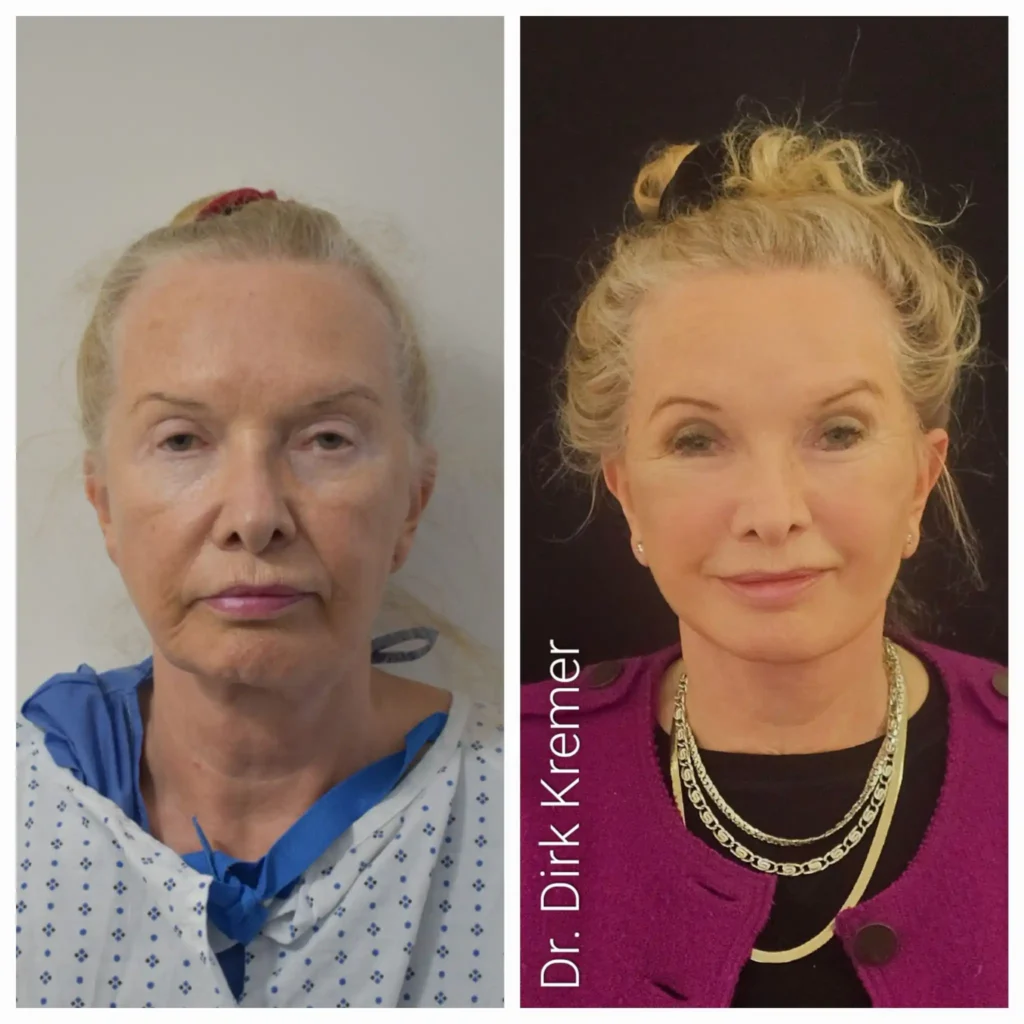
Performed under general anaesthesia, I, Dr. Dirk Kremer, make discreet incisions hidden along the hairline and around the ears. The deep plane technique involves releasing the facial ligaments and lifting the facial tissue—including skin and SMAS—as one unit. Excess skin and excess fat may be removed or repositioned to restore youthful facial contours.
During the procedure, I carefully reposition the underlying tissues to their youthful position, often incorporating fat grafting to restore volume using healthy fat cells harvested from other areas of the body. This fat transfer provides a natural alternative to dermal fillers with longer-lasting results.
I may combine the facelift with complementary cosmetic procedures such as neck lift, eyelid surgery, or brow lift for comprehensive facial rejuvenation. Combining procedures can enhance overall facial harmony and reduce the need for multiple surgeries.
Most patients experience swelling and bruising for 1 to 3 weeks post surgery. Pain is managed with prescribed pain medication, and a compression garment helps reduce swelling. Sutures are typically removed within 7 to 10 days by the surgeon during follow-up visits.
The recovery is generally smoother than traditional facelifts due to less tension on the skin. Most patients resume light activities within 2 weeks and normal exercise by 6 weeks. Follow-up visits with your surgeon ensure proper healing and optimal results.
Compared to the SMAS facelift or traditional facelift procedure, the deep plane facelift technique offers:
While the SMAS facelift lifts the superficial musculoaponeurotic system separately from the skin, the deep plane facelift lifts both layers together, resulting in a stronger, more natural lift that better resists the effects of gravity over time.
The results of a deep plane facelift are considered facelift surgery permanent in terms of structural repositioning, with most patients enjoying benefits for 10 to 15 years. While the natural ageing process continues, the deep repositioning of tissues slows visible signs of ageing significantly.
Maintaining a healthy lifestyle, good skincare, and sun protection will help prolong your youthful appearance after surgery.
The cost of a deep plane facelift London varies depending on the complexity of the surgery and any additional procedures combined. Prices typically start from £18,000. A personalized quote will be provided after your consultation, ensuring transparency and tailored care.
Investing in a skilled cosmetic surgeon ensures optimal results and minimizes risks, making the cost worthwhile for a natural and lasting facial rejuvenation.
If you are ready to restore your youthful appearance with natural, long-lasting results, contact our Harley Street clinic today to schedule your consultation with a board certified plastic surgeon specializing in the deep plane facelift London. Experience the benefits of this surgical procedure designed for profound and natural facial rejuvenation.
This procedure helps to elevate the lower strata of the face under the SMAS, and the facial retaining ligaments are liberated, and the cheek and midface tissues are rearranged as one unit. Reforming the anatomical descent of the facial structures, it recreates the contour of youth and forms the face shape better than conventional facelifts.
This facelift can be chosen by patients as it rejuvenates without giving them the appearance of being stretched or pulled. It is the deeper tissues that carry the tension and not the skin, which enables the skin to move smoothly and naturally and also gives the person a refreshed appearance without losing his or her character.
Signs of ageing, like sagging cheeks, nasolabial folds, marionette lines, jowls, and heaviness of the lower face, are greatly enhanced using this technique. Together with a neck lift, it can also remodel the jaw and make the neck-chin shape more sculpted.
The deep tissues are also raised at the point of origin, hence showing a result that lasts 10 to 15 years or more. The repositioned structures stand up against gravitational descent much longer than those methods acting on tightening the skin or plating the SMAS.
The composite flap technique maintains blood flow to the skin, reduces the risk of healing complications, and yields finer, less conspicuous scars. A smoother, more comfortable recovery is also achieved with reduced skin tension.
The deep plane technique is one of the strongest, most natural, and longest-lasting methods of facial rejuvenation, whether it is the first facelift or an attempt to mitigate the limitations of older procedures.
A deep plane facelift is an advanced surgical technique that lifts the skin and the underlying SMAS (superficial musculoaponeurotic system) as a composite unit, rather than treating the skin and muscle layers separately as in traditional facelift methods. By releasing key facial retaining ligaments, the deep plane technique allows the surgeon to reposition the deeper facial tissues — including the cheeks, midface, and jowl area — addressing the structural layers of facial ageing rather than simply tightening the skin.
The result is a more natural and refreshed appearance with longer-lasting structural support. At Harley St Aesthetics, Dr. Dirk J. Kremer performs deep plane facelifts alongside his Vertical Dual-Plane technique, allowing a bespoke approach tailored to each patient’s facial anatomy.
A deep plane facelift works beneath the SMAS layer to release the facial retaining ligaments that tether the deeper tissues in place. This allows the cheeks, nasolabial folds, jowls, marionette lines, and lower face to be repositioned in a more vertical and natural direction, rather than simply being pulled laterally, which can create an unnatural or “windswept” appearance. By repositioning descended facial tissues, the technique restores more youthful contours rather than merely tightening the skin. When combined with a neck lift, it can also improve jawline definition and address laxity in the neck. Areas treated typically include the midface, jawline, jowls, lower face, and neck.
An extended deep plane facelift is a variation of the deep plane technique that involves more extensive release of the facial retaining ligaments and broader mobilisation of the midface tissues. By extending the dissection further into the midface, the surgeon can achieve greater repositioning of descended facial structures.
This approach can be particularly beneficial for patients with more advanced facial ageing, heavier jowls, deeper nasolabial folds, or those seeking more significant facial rejuvenation. It may also be suitable for certain patients who have previously undergone facelift surgery and require a more extensive revision.
During your personalised consultation, Dr. Dirk J. Kremer will assess your facial anatomy and discuss whether a standard deep plane facelift or an extended deep plane technique would be most appropriate.
The Vertical Dual-Plane facelift is Dr. Dirk J. Kremer’s signature refinement of the deep plane facelift. The technique combines two complementary levels of tissue repositioning — a deep plane lift of the SMAS and facial structures, together with an additional vertical suspension in a more superficial plane.
The first stage involves a deep plane facelift, in which the skin and SMAS are mobilised together and key retaining ligaments are released. This allows the deeper facial tissues to be repositioned in a natural superolateral direction.
In selected patients — particularly those with heavier jowls or greater lower-face volume — Dr. Kremer adds a second, more superficial component. Through carefully placed suspension sutures in the subcutaneous plane, the midface tissues can be further supported in a vertical direction. This additional lift enhances cheek contour and helps redistribute volume from the lower face toward the midface.
By combining these two planes of repositioning, the Vertical Dual-Plane technique can achieve stronger midface support and more harmonious facial balance while maintaining a natural appearance.
The technique was developed by Dr. Kremer and is performed exclusively within his practice as part of a personalised surgical approach.
In many patients, the face and neck age together, so treating both areas can produce the most balanced and natural-looking result. While a deep plane facelift effectively repositions the deeper facial tissues and improves the jawline and midface, it may not fully address neck laxity, platysmal banding, or excess submental fat.
For this reason, a neck lift is often performed at the same time as a facelift to improve the contour of the jawline and neck. Combining the procedures allows the lower face and neck to be treated as a single aesthetic unit, creating a more harmonious overall result.
During consultation, Dr. Dirk J. Kremer carefully assesses the face and neck to determine whether a neck lift would be beneficial and discusses the most appropriate surgical plan based on your anatomy and goals.
Yes. A deep plane facelift is often combined with complementary procedures to achieve balanced facial rejuvenation. Common combinations include eyelid surgery (blepharoplasty) to refresh the eye area, a brow lift to improve the position of the forehead and brows, a neck lift to enhance the jawline and neck contour, and fat grafting to restore facial volume using the patient’s own tissue.
Performing these procedures together allows multiple areas of facial ageing to be addressed in a single operation and avoids the need for separate procedures and recovery periods.
During consultation, Dr. Dirk J. Kremer will assess your facial anatomy and discuss which combination of procedures may provide the most natural and harmonious result.
The cost of a deep plane facelift in London at Harley Street Aesthetics starts from £18,000. The final cost depends on the complexity of the procedure and the individual surgical plan.
Some patients benefit from combining a facelift with additional procedures such as a neck lift, eyelid surgery, or fat grafting, which can influence the overall treatment plan and cost.
Following your consultation, Dr. Dirk J. Kremer will provide a personalised surgical recommendation together with a clear and transparent cost breakdown.
At Harley Street Aesthetics, the quoted price for your deep plane facelift includes the surgeon’s fee, anaesthetist’s fee, hospital facility costs, post-operative garments, and follow-up appointments.
A detailed written breakdown of all costs is provided after your consultation so you can make a fully informed decision about your treatment.
If additional procedures such as a neck lift or fat grafting are recommended, these will be discussed during your consultation and included in your personalised surgical plan.
While deep plane facelift surgery abroad may appear less expensive initially, it is important to consider the full picture. The deep plane facelift is one of the most technically demanding procedures in facial surgery and outcomes depend heavily on the surgeon’s training, experience, and understanding of facial anatomy.
Travelling internationally for surgery can also introduce practical challenges. Recovery after a facelift requires careful monitoring, and access to your surgeon for follow-up care may be limited once you return home. Managing complications or concerns from a distance can therefore be more difficult.
Many patients choose to have their surgery closer to home so that they can benefit from consistent follow-up care and direct access to their surgeon throughout the recovery process.
During consultation, Dr. Dirk J. Kremer will explain the procedure in detail and outline the full care pathway so that you can make a well-informed decision about where to have your surgery.
When selecting a surgeon for a deep plane facelift, it is important to look for specific expertise and experience in advanced facial rejuvenation techniques. Factors to consider include:
• extensive and verifiable experience performing deep plane facelifts, rather than general facelift surgery alone
• membership of recognised national or international professional organisations in plastic and aesthetic surgery
• a portfolio of before-and-after photographs demonstrating consistent, natural-looking results
• clear and transparent communication about risks, recovery, and realistic expectations
• a surgical approach tailored to the individual patient’s facial anatomy rather than a standardised technique
Dr. Dirk J. Kremer specialises in deep plane facelift surgery and advanced facial rejuvenation techniques. During consultation, he carefully evaluates each patient’s anatomy and discusses the most appropriate surgical approach to achieve natural and balanced results.
Dr. Dirk J. Kremer is a plastic surgeon with over two decades of experience performing facelift surgery. He performed his first facelift in 2005 and has since developed extensive expertise in facial rejuvenation procedures, working with a wide range of surgical facelift techniques over the course of his career.
This depth of experience allows Dr. Kremer to carefully select the most appropriate technique for each patient. While he specialises in the deep plane facelift, he has also worked with multiple established facelift approaches over the years, giving him a comprehensive understanding of facial anatomy, ageing patterns, and surgical strategy.
Dr. Kremer’s broad experience across different facelift techniques has also allowed him to refine and modify the deep plane facelift for patients with heavier jowls and greater lower-face volume. From this work, he developed his signature Vertical Dual-Plane technique — a tailored refinement designed to improve tissue repositioning and enhance midface support in selected patients.
Practising on Harley Street in London, Dr. Kremer provides personalised care throughout the entire surgical journey — from consultation and surgical planning to post-operative follow-up. Patients travel from across the UK and internationally to seek his expertise in advanced facelift surgery.
A personalised consultation is the first step in determining the most appropriate surgical approach for achieving natural and balanced facial rejuvenation.
Most patients undergoing a deep plane facelift experience bruising and swelling for approximately one to three weeks. Because the deep plane technique repositions the deeper facial tissues rather than placing tension primarily on the skin, the skin can be redraped more naturally, which helps optimise scar healing.
Sutures are typically removed within nine to fourten days. Most patients feel comfortable resuming light daily activities after around two weeks, while more strenuous exercise is usually avoided for approximately six weeks.
Dr. Dirk J. Kremer provides detailed post-operative instructions and follow-up appointments to monitor healing and support patients throughout the recovery process.
A deep plane facelift produces long-lasting structural improvement by repositioning the deeper facial tissues and restoring more youthful facial contours. However, it is important to understand that a facelift does not stop the natural ageing process.
After surgery, the face continues to age gradually. Many patients look significantly younger after their procedure — often turning the clock back by many years — but the skin and tissues still age biologically over time.
Rather than thinking of a facelift as something that “lasts” a fixed number of years, it is more accurate to say that it resets the ageing process to a more youthful starting point. Even 10 or 15 years after surgery, most patients still look better than they would have if they had never had a facelift.
Some patients eventually choose to undergo another facelift after 10–15 years as ageing continues, while others remain happy with their results for longer. The longevity of results also depends on factors such as genetics, skin quality, sun exposure, skincare, and overall lifestyle.
During consultation, Dr. Dirk J. Kremer explains how facial ageing works and how to maintain the best possible long-term results after surgery.
All surgical procedures involve scars, but facelift incisions are carefully placed so that they heal as discreetly as possible. In a deep plane facelift, the incisions are typically positioned along the natural contours of the hairline and around the ears, where they are well concealed within natural skin folds.
Because the deep plane technique places the lifting tension in the deeper tissue layers rather than the skin itself, the skin can be redraped more gently. This helps create favourable conditions for fine, well-healed scars.
Over time, facelift scars usually fade and soften, becoming increasingly difficult to notice. Dr. Dirk J. Kremer also provides detailed aftercare instructions to support optimal scar healing.
Good candidates for a deep plane facelift are typically patients who are experiencing moderate to significant facial ageing, such as sagging cheeks, jowls, deep nasolabial folds, marionette lines, or laxity along the jawline and neck that cannot be effectively improved with non-surgical treatments alone.
While many patients considering a facelift are in their 40s to 70s, suitability depends more on the degree of facial ageing, skin quality, and overall facial anatomy than on age alone.
Patients should be in good general health and ideally be non-smokers or willing to stop smoking before and after surgery to support proper healing.
During consultation, Dr. Dirk J. Kremer performs a detailed facial assessment to determine whether a deep plane facelift, a combined face and neck lift, or another surgical approach would be the most appropriate option for achieving natural and balanced results.
As with any surgical procedure performed under general anaesthesia, a deep plane facelift carries potential risks. These can include bruising, swelling, temporary changes in skin sensation, scarring, infection, and haematoma (a collection of blood beneath the skin). In some cases, temporary hair thinning near the incision sites or minor contour irregularities may occur during the healing process.
Very rarely, temporary weakness of branches of the facial nerve can occur. Permanent nerve injury is extremely uncommon. In smokers or patients with compromised circulation, there is also a small risk of delayed wound healing or skin healing problems.
Because the deep plane technique involves operating close to important facial structures, it requires detailed anatomical knowledge and careful surgical technique. When performed by an experienced facial surgeon, these risks are carefully managed and minimised.
A thorough pre-operative assessment helps identify individual risk factors, and patients receive detailed post-operative guidance and follow-up care to support safe healing and recovery.
Address